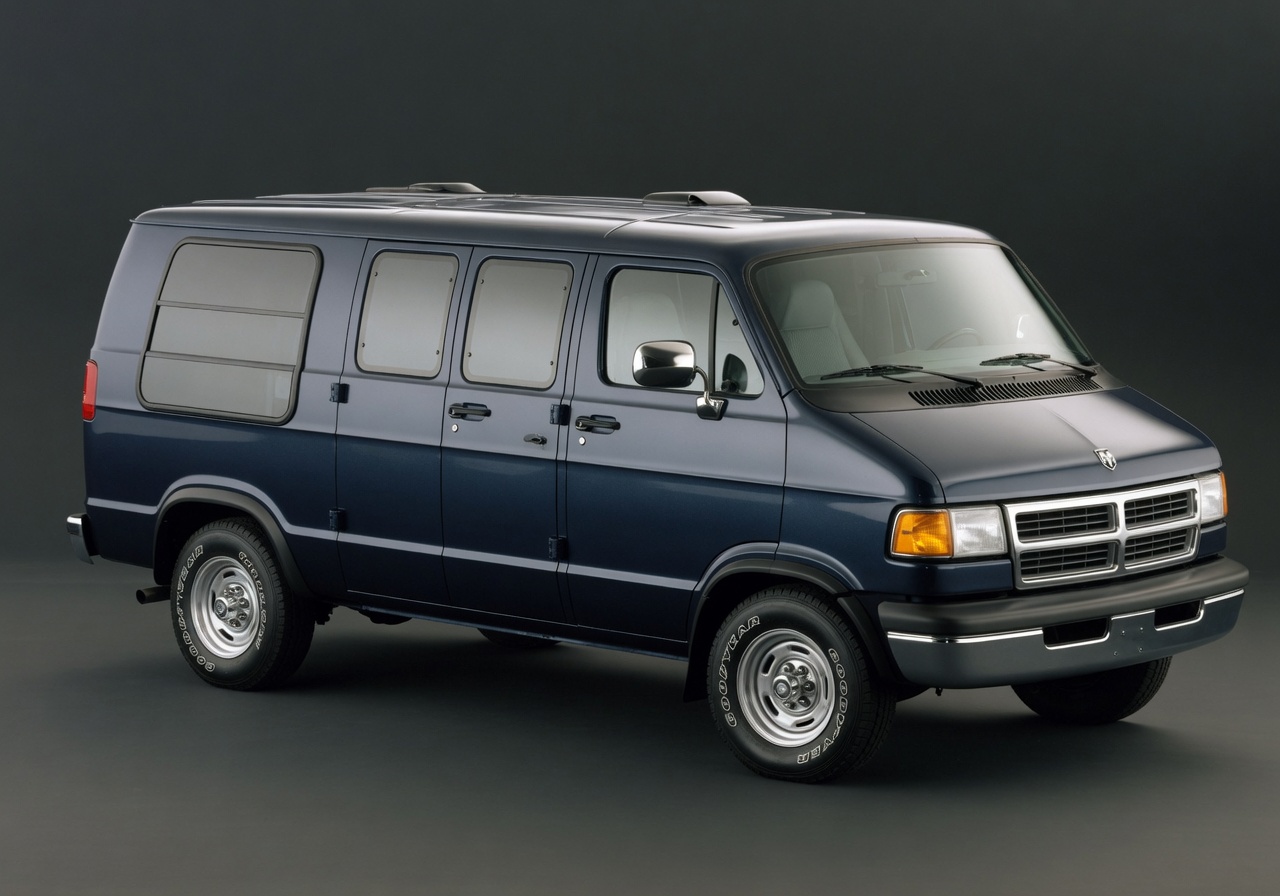
1993 Dodge Ram Van B250 Van/Minivan

1993 Dodge

Ram Van B250Van/Minivan

5.2L V8 (318 cu in) · Van/Minivan

The 1993 Dodge Ram Van B250 is a full-size, body-on-frame cargo and passenger van built on Chrysler's long-running B-series platform — a design that traces its roots to the 1970s. By 1993 it was a mature, proven platform known more for durability and payload capacity than refinement or fuel economy. The B250 sits in the middle of the B-series lineup (B150, B250, B350), rated for 3/4-ton duty and commonly configured as a cargo van, conversion van, or 8-15 passenger hauler. Under the hood, most B250s left the factory with Chrysler's 5.2L (318 cu in) V8 paired to a 3-speed TorqueFlite automatic — a combination that is legendarily simple to maintain and rebuild. The engine bay is wide open compared to modern vehicles, making DIY and shop work straightforward. Parts availability is excellent because this platform shared components with Dodge trucks and Dakota pickups for decades. By 2025, any surviving B250 is at minimum 32 years old. Rust, dried seals, and deferred maintenance are the real enemies at this point — not fundamental mechanical weakness. A well-kept example with receipts is a capable work or adventure vehicle; a neglected one can turn into a money pit fast.

Reliability
3/5
Verified data
Engine
5.2L V8 (318 cu in)
Drivetrain
RWD
Fuel
Gasoline
MPG
13 city / 17 hwy / 15 combined
Seats
8
Doors
3
Body
Van
MSRP
$18,500

Overview

AI-curated

The 1993 Dodge Ram Van B250 is a full-size, body-on-frame cargo and passenger van built on Chrysler's long-running B-series platform — a design that traces its roots to the 1970s. By 1993 it was a mature, proven platform known more for durability and payload capacity than refinement or fuel economy. The B250 sits in the middle of the B-series lineup (B150, B250, B350), rated for 3/4-ton duty and commonly configured as a cargo van, conversion van, or 8-15 passenger hauler. Under the hood, most B250s left the factory with Chrysler's 5.2L (318 cu in) V8 paired to a 3-speed TorqueFlite automatic — a combination that is legendarily simple to maintain and rebuild. The engine bay is wide open compared to modern vehicles, making DIY and shop work straightforward. Parts availability is excellent because this platform shared components with Dodge trucks and Dakota pickups for decades. By 2025, any surviving B250 is at minimum 32 years old. Rust, dried seals, and deferred maintenance are the real enemies at this point — not fundamental mechanical weakness. A well-kept example with receipts is a capable work or adventure vehicle; a neglected one can turn into a money pit fast.

Known for
  • Rugged body-on-frame construction with excellent payload capacity
  • Simple, rebuildable 5.2L V8 and TorqueFlite automatic drivetrain
  • Wide-open engine bay that makes service straightforward
  • Long production run means abundant, inexpensive parts
  • Favored by tradespeople, camper converters, and church fleets for decades
Best for
  • Cargo hauling and tradesperson use
  • DIY camper van conversions
  • Budget-conscious buyers needing high payload
  • Owners comfortable with older-vehicle maintenance
  • Rural or low-mileage secondary work vehicles
Watch for
  • Pervasive rust on frame rails, rocker panels, and floor pans — especially from Wisconsin salt use
  • Dried or cracked rubber: door seals, intake manifold gaskets, fuel hoses, brake lines
  • Unknown maintenance history on high-mileage examples
  • Rear leaf spring and shock condition on vehicles that hauled heavy loads
  • Cooling system neglect — 3.5L and 5.2L V8s are vulnerable to overheating when coolant goes old

Common issues by mileage

6 known

Frame and floor pan rust

high
Typically appears
All mileages — age-driven
Estimated repair
$500 – $4,000

Intake manifold gasket failure (5.2L V8)

high
Typically appears
80k–150k mi
Estimated repair
$300 – $650

Brake line corrosion and failure

high
Typically appears
All mileages — age-driven
Estimated repair
$400 – $1,200

Fuel system degradation (hoses, pump, carburetor/TBI injectors)

medium
Typically appears
All mileages — age-driven
Estimated repair
$200 – $900

Cooling system failure (thermostat, hoses, water pump)

medium
Typically appears
60k–120k mi
Estimated repair
$150 – $600

Rear leaf springs and shock absorbers worn (especially on payload-hauling units)

medium
Typically appears
80k+ mi
Estimated repair
$250 – $800

Maintenance schedule

  1. 1
    Every 3,000–5,000 miles or annually (whichever comes first) Engine oil and filter change

    The 5.2L V8 predates extended-drain oil specs. Conventional oil and short intervals are appropriate for this engine age. Annual changes are essential even on low-mileage vehicles.

  2. 2
    Every 2 years or 30,000 miles Coolant flush and inspection of all hoses and clamps

    Rubber hoses and coolant degrade quickly on 30+ year-old vehicles. Old coolant turns acidic and attacks the aluminum intake and water pump. A boilover can cause serious engine damage.

  3. 3
    Every year, before winter and before long trips Brake line and wheel cylinder inspection

    Steel brake lines on vehicles exposed to Wisconsin road salt rust from the outside in. A line failure is a safety emergency. Replace any line showing external rust scale or pitting.

  4. 4
    Every 30,000 miles Transmission fluid and filter service

    The TorqueFlite automatic is robust but benefits from clean fluid. Dark or burnt-smelling fluid indicates overdue service. Fresh fluid can extend transmission life significantly.

  5. 5
    Every 2 years Fuel hose and fuel pump inspection

    Original rubber fuel hoses are now over 30 years old. Cracking and weeping at fittings is a fire risk. Inspect and replace any hose that is stiff, cracked, or shows fuel staining.

  6. 6
    Every oil change Chassis lubrication (grease fittings on front suspension, steering)

    The B250 has traditional grease zerks throughout the front end and steering linkage. Dry joints wear quickly and cause loose, wandering steering.

  7. 7
    Every fall before Wisconsin winter Battery load test

    Cold cranking a high-compression V8 at sub-zero temps stresses any battery. A battery that tests marginal in October will likely fail in January.

  8. 8
    Every spring after winter Inspect door seals, body seams, and floor for rust penetration

    Salt accumulates in seams over winter. Early rust treatment is far cheaper than floor pan or rocker panel replacement. Clean the undercarriage each spring.

Always defer to the manufacturer's service manual for warranty-mandated intervals.

Cost of ownership

Annual maintenance
$600 – $2,000
Fuel
At roughly 15 MPG combined and today's Wisconsin gas prices, expect $2,000–$3,200/year at 15,000 miles annually. This is one of the highest fuel costs in the segment.
Insurance
Liability-only insurance on a vehicle this age is typically inexpensive — often $400–$800/year. If you add comprehensive, the low market value of most B250s may not justify the premium.

Day-to-day parts and service costs are low — this platform is simple and parts are cheap. The wildcard is age-related repairs: brake lines, fuel system, rust remediation, and cooling system work can each run several hundred to over a thousand dollars. Budget for one or two moderate surprises per year. Fuel is the biggest ongoing expense given the 5.2L V8's appetite.

Seasonal care

Lake Geneva, WI
Winter
  • Load-test the battery every October — a marginal battery will not start a cold V8 at -10°F. Replace proactively if it's more than 3–4 years old.
  • Switch to 5W-30 conventional oil if running 10W-30 in summer; cold starts on thick oil wear the 5.2L V8 quickly.
  • Flush the washer fluid reservoir and fill with -20°F or colder rated fluid — the large windshield on this van gets heavily salt-sprayed.
  • Inspect brake lines closely before winter. Wisconsin salt will accelerate any existing corrosion to a failure point.
  • Check antifreeze protection to at least -34°F with a test strip or refractometer — old coolant loses freeze protection even if the level looks fine.
  • Carry a set of jumper cables or a jump pack; the B250's electrical system and high-compression V8 put heavy demands on a cold battery.
Summer
  • Inspect the serpentine/V-belts and hoses before hot-weather driving — the 5.2L runs warm and a cracked hose or slipping belt can cause rapid overheating.
  • Check tire pressure monthly; large cargo van tires lose significant pressure in heat and are often underinflated on older vehicles.
  • Clean and test the A/C system if equipped — R-12 refrigerant was factory-fill; a retrofit to R-134a may have been done previously, so verify what's in the system before adding refrigerant.
  • Flush the radiator if coolant is more than 2 years old — summer heat and old coolant is a recipe for overheating with a V8 working hard.
  • Check rear cargo area ventilation on conversion or passenger vans — the large enclosed body traps heat quickly when parked.

Comparable vehicles

If you're shopping for one

Red flags
  • Any soft or holed areas in the floor pan or frame — structural rust at this age is rarely worth the repair cost
  • Fresh undercoating sprayed over the frame — a common way to hide active rust from buyers
  • No maintenance records whatsoever on a high-mileage example
  • Coolant that is brown, oily, or has a sweet exhaust smell — points to head gasket or intake manifold failure
  • A transmission that slips, delays engagement, or hunts between gears — rebuilds are $1,200–$2,500
  • Evidence of a salvage title or collision repair on a body-on-frame van — frame straightness is critical and hard to verify cheaply
What to inspect
  • Put the van on a lift and probe every frame rail, crossmember, and floor pan seam with a screwdriver — soft or flaking metal is a deal-breaker
  • Check all steel brake lines end-to-end for external rust scale, pitting, or bulging rubber flex hoses
  • Start cold and watch for blue smoke (worn rings/valve seals) or white smoke (coolant in combustion from intake gasket)
  • Check transmission fluid color and smell on the dipstick — black or burnt fluid means overdue service or internal wear
  • Inspect all rubber fuel hoses in the engine bay for cracking, stiffness, or fuel staining at clamps
  • Open every door and inspect the door sill, inner floor edge, and B-pillar bases for rust bubbling under the paint
  • If a conversion van, inspect the floor of the living area for water intrusion and soft subfloor from roof or window leaks
AI profile generated 7 days ago · claude-sonnet-4-6 · v2.