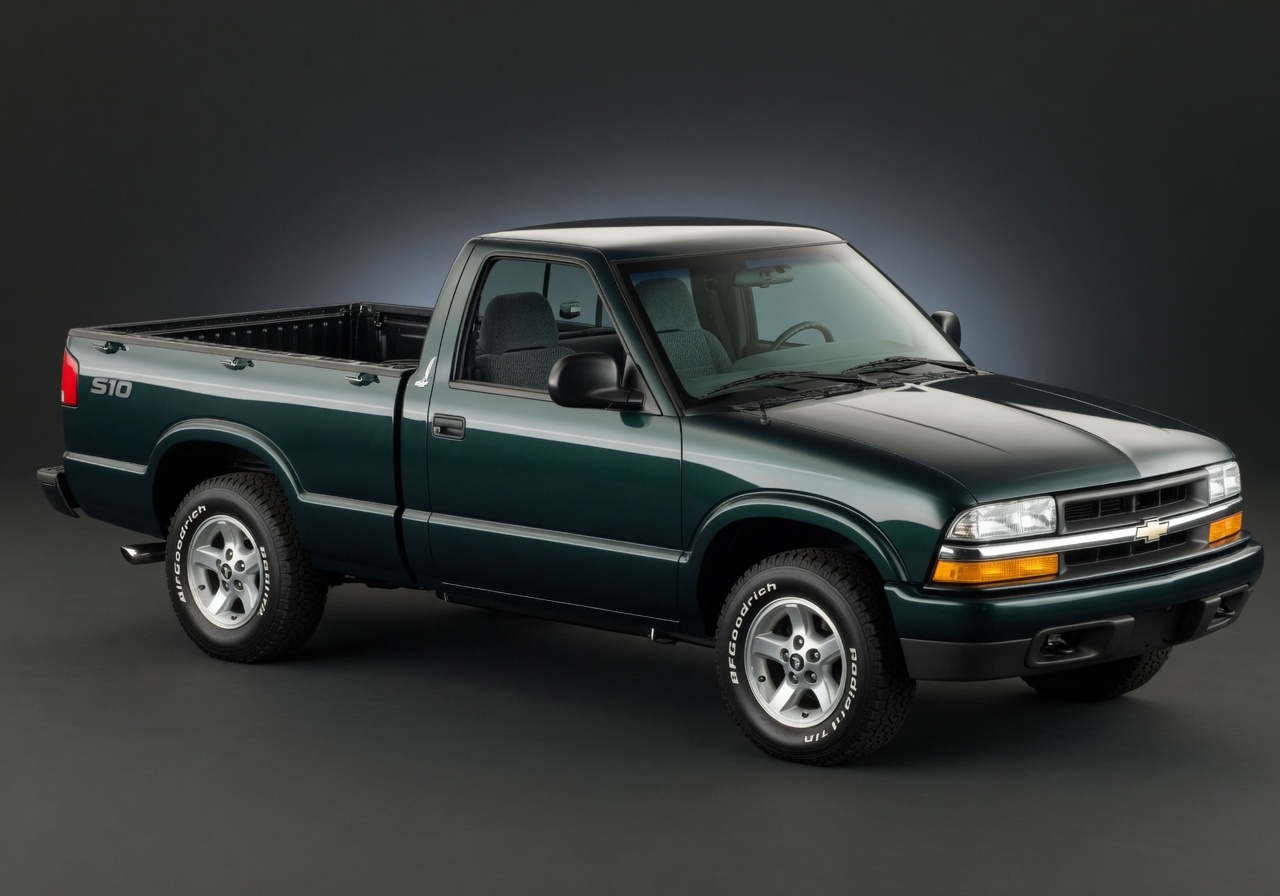
1996 Chevrolet S10 Regular Cab Pickup

1996 Chevrolet

S10 Regular CabPickup

4.3L V6 · Pickup

The 1996 Chevrolet S10 Regular Cab is a compact pickup from GM's long-running S-series platform, which ran from 1982 through 2004. By 1996 the truck had matured into a known quantity — simple body-on-frame construction, a choice of four-cylinder or V6 power, and a reputation for being cheap to buy and easy to wrench on. It was never a powerhouse, but it earned a following as a lightweight daily driver and light-duty hauler. At nearly 30 years old, any surviving S10 is now a vintage work truck. Parts availability is still good thanks to the long production run and shared components with the GMC Sonoma, but rust is the single biggest threat — especially on trucks that spent their lives in salt-belt states like Wisconsin. Expect surface rust at minimum; severe structural rust is common on unprotected examples. For a buyer or current owner, the 1996 S10 is best thought of as a simple, affordable truck that rewards regular maintenance and attentive rust management. Major mechanical repairs are inexpensive compared to modern vehicles, and a solid example can still serve as reliable light-duty transportation.

Reliability
3/5
Verified data
Engine
4.3L V6
Drivetrain
RWD
Fuel
Gasoline
MPG
18 city / 24 hwy / 20 combined
Seats
3
Doors
2
Body
Pickup
MSRP
$11,000

Overview

AI-curated

The 1996 Chevrolet S10 Regular Cab is a compact pickup from GM's long-running S-series platform, which ran from 1982 through 2004. By 1996 the truck had matured into a known quantity — simple body-on-frame construction, a choice of four-cylinder or V6 power, and a reputation for being cheap to buy and easy to wrench on. It was never a powerhouse, but it earned a following as a lightweight daily driver and light-duty hauler. At nearly 30 years old, any surviving S10 is now a vintage work truck. Parts availability is still good thanks to the long production run and shared components with the GMC Sonoma, but rust is the single biggest threat — especially on trucks that spent their lives in salt-belt states like Wisconsin. Expect surface rust at minimum; severe structural rust is common on unprotected examples. For a buyer or current owner, the 1996 S10 is best thought of as a simple, affordable truck that rewards regular maintenance and attentive rust management. Major mechanical repairs are inexpensive compared to modern vehicles, and a solid example can still serve as reliable light-duty transportation.

Known for
  • Simple, repairable mechanical systems with widely available parts
  • Lightweight platform — easy on tires and brakes
  • Long production run means the 4.3L V6 is one of the most-serviced small-truck engines in the country
  • Prone to significant frame and body rust in northern climates
  • Budget-friendly acquisition and repair costs
Best for
  • Light hauling and around-town errands
  • Budget-conscious owners comfortable with basic DIY maintenance
  • Classic/project truck enthusiasts
  • Secondary or farm use vehicles
Watch for
  • Frame rust — check the full length including cab corners and crossmembers
  • Fuel tank and sending unit corrosion (in-tank pump on later models)
  • 4.3L V6 spider injector (CSFI) leaks causing rough idle and fuel smell
  • Automatic transmission wear if service intervals were skipped
  • Worn-out steering components — idler arm and center link are high-wear items

Common issues by mileage

6 known

4.3L V6 Spider Injector (CSFI) Leaks

high
Typically appears
80–150k mi
Estimated repair
$300 – $650

Fuel Pump Failure (In-Tank)

high
Typically appears
100–175k mi
Estimated repair
$250 – $450

Steering Idler Arm and Center Link Wear

high
Typically appears
75–130k mi
Estimated repair
$200 – $450

Automatic Transmission Wear / Slipping (4L60-E)

medium
Typically appears
120–180k mi
Estimated repair
$900 – $2,200

Frame and Body Rust (Cab Corners, Frame Rails, Crossmembers)

high
Typically appears
Any mileage — age/salt-exposure dependent
Estimated repair
$200 – $3,000

Distributor Cap, Rotor, and Ignition Wire Degradation

medium
Typically appears
60–100k mi
Estimated repair
$80 – $200

Maintenance schedule

  1. 1
    Every 5,000 miles or 6 months Engine oil and filter change

    The 4.3L runs conventional oil from the factory. At this age, consistent intervals prevent sludge buildup in a high-mileage engine.

  2. 2
    Every 30,000 miles Fuel filter replacement

    The inline fuel filter protects the spider injector assembly. Neglecting it accelerates injector wear and can mask a failing fuel pump.

  3. 3
    Every 30,000 miles Automatic transmission fluid and filter service (4L60-E)

    The 4L60-E is sensitive to dirty fluid. Skipped services dramatically shorten transmission life on high-mileage examples.

  4. 4
    Every 15,000 miles or annually Inspect and grease front-end steering components

    Idler arm, center link, and tie rod ends wear quickly on these trucks. Early detection saves costly steering repair and prevents handling danger.

  5. 5
    Every spring (post-salt-season) Inspect and treat frame and underbody for rust

    Wisconsin road salt accelerates frame rail corrosion. Annual inspection and undercoating significantly extends structural life.

  6. 6
    Every 30,000 miles Distributor cap, rotor, and spark plug replacement

    The 4.3L uses a conventional distributor that is sensitive to moisture intrusion — especially important in Wisconsin humidity and winter.

  7. 7
    Every 2 years Inspect fuel tank straps and sending unit for rust

    Tank straps and the fuel sender are directly exposed to road salt and often rust through on upper Midwest trucks. Failure can cause tank drop or inaccurate fuel readings.

  8. 8
    Every 2 years or 30,000 miles Coolant flush

    Degraded coolant causes water pump seal failure and corrosion inside the block — a particular concern on a nearly 30-year-old engine.

Always defer to the manufacturer's service manual for warranty-mandated intervals.

Cost of ownership

Annual maintenance
$400 – $900
Fuel
Averaging ~20 MPG combined with the 4.3L V6, expect roughly $1,500–$2,000/year at typical Wisconsin driving distances and current fuel prices.
Insurance
Liability-only insurance on a vehicle this age is typically $400–$700/year in Wisconsin. Full coverage on a low-value truck rarely makes financial sense.

The S10 is one of the lower-cost trucks to own day-to-day. Parts are cheap and plentiful, and independent shops know these trucks well. The big wildcard is rust repair — a single season of neglected underbody corrosion can turn a $500 fix into a $2,500 one. Budget for rust remediation if you're in the Lake Geneva area.
Seasonal care

Lake Geneva, WI
Winter
  • Switch to 5W-30 conventional or synthetic oil before temperatures drop below 0°F to ensure cold-start lubrication — the 4.3L can be slow to oil pressure on thick cold oil.
  • Test the battery every fall. A battery over 4 years old that passes summer is not guaranteed to start the truck at -10°F; load-test it before November.
  • Use a winter-rated washer fluid rated to at least -20°F. The S10's reservoir is underhood and exposed to cold air — a frozen washer line is a safety hazard in Wisconsin winters.
  • Inspect and replace wiper blades with winter-style blades before the first snowfall. The S10's wiper system is basic and struggles with clogged blade frames.
  • Flush undercarriage with fresh water weekly during heavy salt season — especially the frame rails, wheel wells, and fuel tank area.
  • Check antifreeze protection level; should be good to at least -34°F for Wisconsin winters.
Summer
  • Check tire pressure monthly — tire pressure drops roughly 1 PSI for every 10°F temperature change, and summer heat can mask slow leaks.
  • Inspect the A/C system for refrigerant level and compressor clutch engagement. The S10's R-134a system (post-retrofit or factory if 1994+) should be checked for leaks at the compressor and condenser fittings.
  • Inspect the cooling system hoses and radiator cap before summer; a heat-soaked engine with a weak cap or cracked hose will overheat quickly in July.
  • Check the serpentine belt for cracking — summer heat accelerates belt degradation on an aging truck.

Comparable vehicles

If you're shopping for one

Red flags
  • Frame rust that has penetrated through the rails — probe with a screwdriver; if it punches through, walk away
  • Fuel smell at idle or in the cab — indicates a leaking spider injector assembly, which is a fire risk
  • Loose or wandering steering — idler arm and center link are expensive to ignore and dangerous
  • Slipping or delayed engagement from the automatic transmission — budget $1,000–$2,200 minimum to address
  • Milky oil or white exhaust smoke — head gasket failure on a 28-year-old engine is a significant investment
  • Missing or incomplete service history — at this age, unknown maintenance history means budgeting for a full fluid service immediately
What to inspect
  • Full frame underside — grab a flashlight and inspect every inch from bumper to bumper for rust perforation
  • Cab corners, bed floor, and rocker panels for rust-through
  • Fuel tank straps and the area around the tank for corrosion and weeping
  • Distributor cap and spark plug wires for cracking or moisture intrusion
  • Steering play — with the truck stationary, check for excessive free play in the steering wheel
  • Transmission fluid condition — should be pink/red, not brown or burnt-smelling
  • All four brake corners — check rotors for deep grooves and hose condition for cracking
AI profile generated 7 days ago · claude-sonnet-4-6 · v2.